Friday, November 4, 2011

Got Manduca Sexta?

Over the past 10 years or so, one of my favorite programs on NPR has been Talk of the Nation's Science Friday!  Sorry, I get excited every time I say Science Friday or "Sci Fri" as it's sometimes referred to.  You can even say TGISF when you wake up on Friday mornings if you're especially excited about the day's topics.

This week, Sci Fri had a segment on a particular flying insect called the Hummingbird Hawk Moth, or Manduca Sexta as they called it (Note:  There is some dispute over the proper name as Manduca Sexta seems to refer to the species with the common name Tomato Hornworm/Carolina Sphinx, while the species with the common name Hummingbird Moth may be known as Hyles lineata, but I've also seen it referred to as Macroglossum Stellatarum, a species of Sphingidae.  I'll ammend this post if/when I ever figure out the actual name.  For now we'll trust the Sci Fri folks and stick with Manduca Sexta.  Sounds cooler anyway).

Hummingbird Hawk Moth.  Pic swiped from http://gardenofeaden.blogspot.com/2008/11/hummingbird-hawk-moth.html
There it is.  Pretty cool, huh?  My interest in this little guy is that I had the pleasure of actually seeing one while I was sitting on the retaining wall behind my apartment having a beer with my neighbors.  At first I thought it was the smallest hummingbird I'd ever seen, because that's exactly what it looks like when you see it.  It flies exactly like a hummingbird, feeds on nectar like a hummingbird, and moves with amazing quickness and dexterity like a hummingbird.

Check out this video from Sci Fri.  The only thing I'll point out is that the video doesn't translate the actual beauty of the moth when you see it in the wild.  Hopefully if I ever see one again I'll have my camera with me instead of a beer, or better yet, camera and a beer. 

Thursday, November 3, 2011

Occupy Harvard

Initially, this post started as an email to my brother Dan.  I'm usually interested in his take on socio-political happenings, and am typically surprised by his responses.  Sometimes I'll make a wager with myself on where his views will land, and I'm often wrong.  This is a good thing.  It shows signs of an intelligent thought process, aspects of critical thinking, and an ability to examine each issue without a predetermined bias (i.e. taking either the left or right side of an issue regardless of facts and details).  In effect, and it pains me to say this, he's not a neanderthal (unlike me in my previous post).

Then, I decided that this issue might be blog-worthy.  It's having to do with the recent Harvard student walkout on a 100 level Economics course because the students felt that Professor Greg Mankiw was not providing a balanced and broad perspective on economic theories.  More specifically, they felt the Mankiw was focusing mostly on the economic theories of free market capitalist Adam Smith, and provided no insight into the macroeconomic theories of John Maynard Keynes.  I'm not going to delve into whose economic theories make more sense because frankly I know little about either of them.  I don't even believe that people who study economics really know anything more than simply the history of economics.  That is, time and time again the "economy" has acted like Mother Nature and just when we thought we had it figured out and could predict events with surprising accuracy, with one fell swoop (2008 Economic Crisis, Japan Tsunami) she (it) throws everything into disarray and let's us know that we are not in control.

For the purposes of this post I'm more interested in people's opinions/views on the act of demonstrating in and of itself.

My email began like this (I copied and pasted and then as you will see I continued the discussion in blog form):

What's your take on this?
http://www.thejournal.ie/economics-students-walkout-of-harvard-to-join-occupy-movement-270343-Nov2011/

Here's the thing, the easy thing for 'Libs (Liberals) to do is applaud them and go about their way.  The easy thing for 'Pubs (Republicans) to do is call them spoiled, whiny little brats and go about their way.  The comments placed by readers at the bottom of the article show the divide.

Could it be, as usual, that the truth lies somewhere in between?  Maybe, but simply saying it lies in between would be taking the easy way out.  Whenever I see dissent, civil disobedience, or sparks of revolution like this (ok, revolution might be too strong a word for this walk-out, but not for Occupy Wallstreet as a whole), I can't help but think of all the walkouts and sit-ins and marches of the 60's and 70's.  Most of the hippie kids involved in the demonstrations were college students and the "spoiled brat" moniker could have easily been applied to them at that time, but you don't get the impression (looking back on it now) that it was.  Now, we look at the demonstrations as a collective movement that when its parts where summed up, created a lot of change (Civil Rights, Environmental Protections, etc.).

Is the act of "walking out" in and of itself a good thing?  Well, let's examine this particular walkout.  I have questions that aren't answered by the article.  I wish I could ask the students the following:  Did you ask the professor why he doesn't teach the theories of Keynes?  Did you inform the professor of your intent to walkout?  Was the walkout an attempt to get the professor (and the university) to require the teachings of Keynes in the economics class or was it to provide publicity to the Occupy Wallstreet movement, or some other motive?

The tone of my questions might suggest that I'm against the walkout when in fact it's the opposite.  I think we are in a time that requires walkouts.  We probably should have never left the time of walkouts and should continually be walking out to protest policies that promote unfair business practices or global inequalities in human standards of living or environmental atrocities.  I'm just saying that the Harvard students took the first step towards being revolutionary (and I assume it was probably one or two students that actually took charge and pushed the idea into a full-fledged walkout), now they need to refine their tactics, examine what worked and what didn't, and learn from the experience.  This same technique could be applied to anything in life, business dealings, management, parenting, etc.

We need to then ask, what if they didn't walk out?  What if they approached the teacher and told him they want to learn more about Keynesian economics and the teacher agreed and began including it in the curriculum?  Would it have been enough to achieve their specific goal, or was there a need to tie this issue into the Occupy Wallstreet movement in order to send a message to all professors/universities who may be biased in their teachings?

What did the walkout do?  It made the news (nationally), and it was another example of discontent, as well as the contagion of public demonstrations.  The endurance of the Occupy Wallstreet movement is what's allowing for (or promoting) the other acts of disobedience we're seeing.

So, is it a good thing?

To be honest, it's hard for me to root against idealistic college students.  Maybe most of them don't exactly know what it's like to live in the "real world" yet, but if they're observant enough to realize that the real world is headed in the wrong direction then why shouldn't they strive to change it for the better.  That's what the movements of the 60's and 70's were about.  Maybe idealism can push things in the right direction and at least provide a chance for change that benefits everyone, as opposed to throwing up our hands and saying, "that's not how the real world works."  The real problem with idealism is that it's often hypocritical, and often abandoned too easily.

I say, keep walking out and keep protesting.  Money can buy a big megaphone, but masses have no need for megaphones as their voices are amplified through sheer numbers.  However, individual responsibility and examination of every issue (not just blindly jumping on any bandwagon) is essential to effectively promoting changes that will benefit society as a whole.

That's my story.  I may or may not stick to it.

Sunday, October 2, 2011

Superferry Returns to Hawaii

Press Release, September 24, 2011

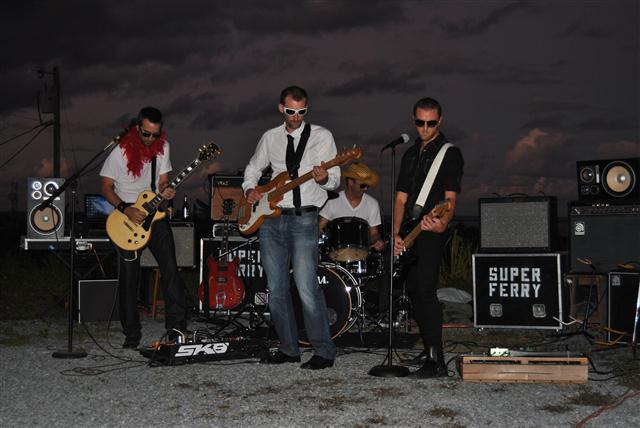
After months of setbacks, record company hostilities, missed deadlines, substance abuse issues, and unsanctioned animal husbandry, Superferry has agreed to terms allowing them to take the stage on September 24th at the Ho'olaule'a BBQ in the parking lot of the Kapiolani Street Apartments.  The fabled writing team of MacKenzie-Curry (formerly Curry-MacKenzie) has assembled a group of slightly better than sub-par musicians to debut their most recent project, Superferry.  Sparks may very literally fly as the band performs outside in one of the rainiest cities in the US.  The Hawaii National Guard has been put on alert as the mere mention of activity from the Superferry camp has incited riots in the past.

Be there to witness the shear awesomeness of America's soon to be favorite train wreck of a band, SUPERFERRY!

(Disclaimer:  Superferry, LLC., is not responsible for deaths or disfigurement due to electric shock or by being slapped in the face by rock n roll!) 


Here's a video of us playing our original song Boys of the Superferry and into The Dandy Warhols' Boys Better.


Saturday, July 16, 2011

Laupahoehoe Point (or, Why did I decide to go to Chemistry Boot Camp?)

I'll start with Chemistry.  I found out that I needed one more Chemistry course a while back, and of all the classes I knew I was going to have to take, this is the one I dreaded the most.  I had hoped that I finished all of my core math and science courses 12 years ago when I tortured myself through three semesters of Calculus, Physics, and Chemistry.  Apparently I didn't torture myself enough.  I needed one more, and to make matters worse it's the second class in a two-class series, one building off the other.  As mentioned, I took the first one 12 years ago and had forgotten about 90% of it so that meant I needed to re-learn most of that material as well.  Oh, and the term is only 5 weeks long, so it's kind of like a Chemistry boot camp of sorts.

So, here I am, 4 weeks into one of the most grueling courses I've ever taken, and on the verge of a week filled with 3 regular exams and a final exam.  If all goes well, next week at this time I'll be enjoying the fact that I'll never have to take another Chem class again!!  Still a big "if" at this point though.

So that's why I haven't blogged in a while.  I really shouldn't be blogging now because I should be studying but I'm so sick of Chemistry I had to take a break from it for a little while.  Let's talk about something else, shall we?


Many of the breakwaters or seawalls here on the Big Island are constructed of these oddly shaped concrete blocks.  I think they look pretty cool.  I have no idea why they're shaped this way and there seems to be no rhyme or reason to the way they're stacked.
(After reading this post my niece Christine sent me a text asking if maybe they were shaped like that to dissipate wave energy, and she was exactly right!  Good job, Christine.  I'll send you an official "I Lived On A Boat" T-shirt and coffee mug as soon as I have them made.  Each block is called a Dolos, plural form is Dolosse, not to be confused with Accropodes, which are a slightly different type of oddly shaped sea-wall block.)
(People keep chiming in on this one.  My brother Dan responded saying they resemble Tetrapods.  He used to see them all over the coasts when he lived in Japan.  Nice guess, but from what I can tell the Tetrapod has a slightly different shape, same purpose though.  No t-shirt or coffee mug, Dan, but thanks for playing.)


I took these pictures at Laupahoehoe Point.  This is yet another incredibly scenic area on The Big Island.  The water here is an amazing looking foamy-blue/green color.  It looks so inviting, but you can't just jump in anywhere because you'd probably get smashed against rocks and pulverized, but like I said, looks inviting.


This is just one of the many beautiful detours on my way to the bank.  I was telling my sister Renee that I love going to the bank here.  The closest branch is 45 minutes away from Hilo in a town called Honoka'a, but the drive there is amazing.  And, if I choose to, I can drive an extra 10 minutes further and see one of the most picturesque views in all of Hawaii, Waipio Valley.


Welp, that's it for today.  Just wanted to say hello to everyone, bitch about Chemistry a little, and share some pics.  Back to the books!

Sunday, June 19, 2011

Our Fathers

Ever since seeing the movie Smoke Signals several years ago, I've occasionally thought about the poem "How Do We Forgive Our Fathers" by Dick Lourie.  It's an incredibly powerful poem, and I don't think I fully understand the whole meaning behind it, but maybe that's the point.  It's a beautiful poem no matter how you look at it, and you can read it many times and interpret it differently each time.  Maybe I like it so much because I think my dad would have liked it (or maybe he did, I don't know if he ever read it).  As a disclaimer, I can't really think of anything I ever needed to forgive my father for, but this poem makes me think of him nonetheless.  This is an emotional poem and my father was an emotional guy.

How Do We Forgive Our Fathers? by Dick Lourie
How do we forgive our Fathers?
Maybe in a dream
Do we forgive our Fathers for leaving us too often or forever
when we were little?
Maybe for scaring us with unexpected rage
or making us nervous
because there never seemed to be any rage there at all.
Do we forgive our Fathers for marrying or not marrying our Mothers?
For Divorcing or not divorcing our Mothers?
And shall we forgive them for their excesses of warmth or coldness?
Shall we forgive them for pushing or leaning
for shutting doors
for speaking through walls
or never speaking
or never being silent?
Do we forgive our Fathers in our age or in theirs
or their deaths
saying it to them or not saying it?
If we forgive our Fathers what is left?
This version of the poem was altered from the original version for the movie Smoke Signals, but I like this version.  I read that Sherman Alexie half-jokingly said that he wrote the book/screenplay for Smoke Signals to lead up to the poem at the end.  Incidentally the original book is called Lone Ranger and Tonto:  Fistfight In Heaven.
If you haven't seen the movie, I highly recommend it.  Spoiler Alert:  The following video is the scene from the end of Smoke Signals where Tomas reads the poem.

This post is dedicated to my Dad, Grandfather, and Lee, Lynn, and Duane McPherson (picture swiped from Lynn's facebook page).

Monday, June 13, 2011

For The Birds

This is the Honey Badger.  No, wait, this is the Honeycreeper.  Sorry, wrong animal.  That video still cracks me up (see Honey Badger by Randall on Youtube).

No, I haven't taken up squishing defenseless little birds.  I started volunteering on a project being conducted by the U.S. Forest Service on various species of the Hawaiian Honeycreeper birds.  I think the one pictured above is an Amakihi.  I'm still trying to get all the names down.

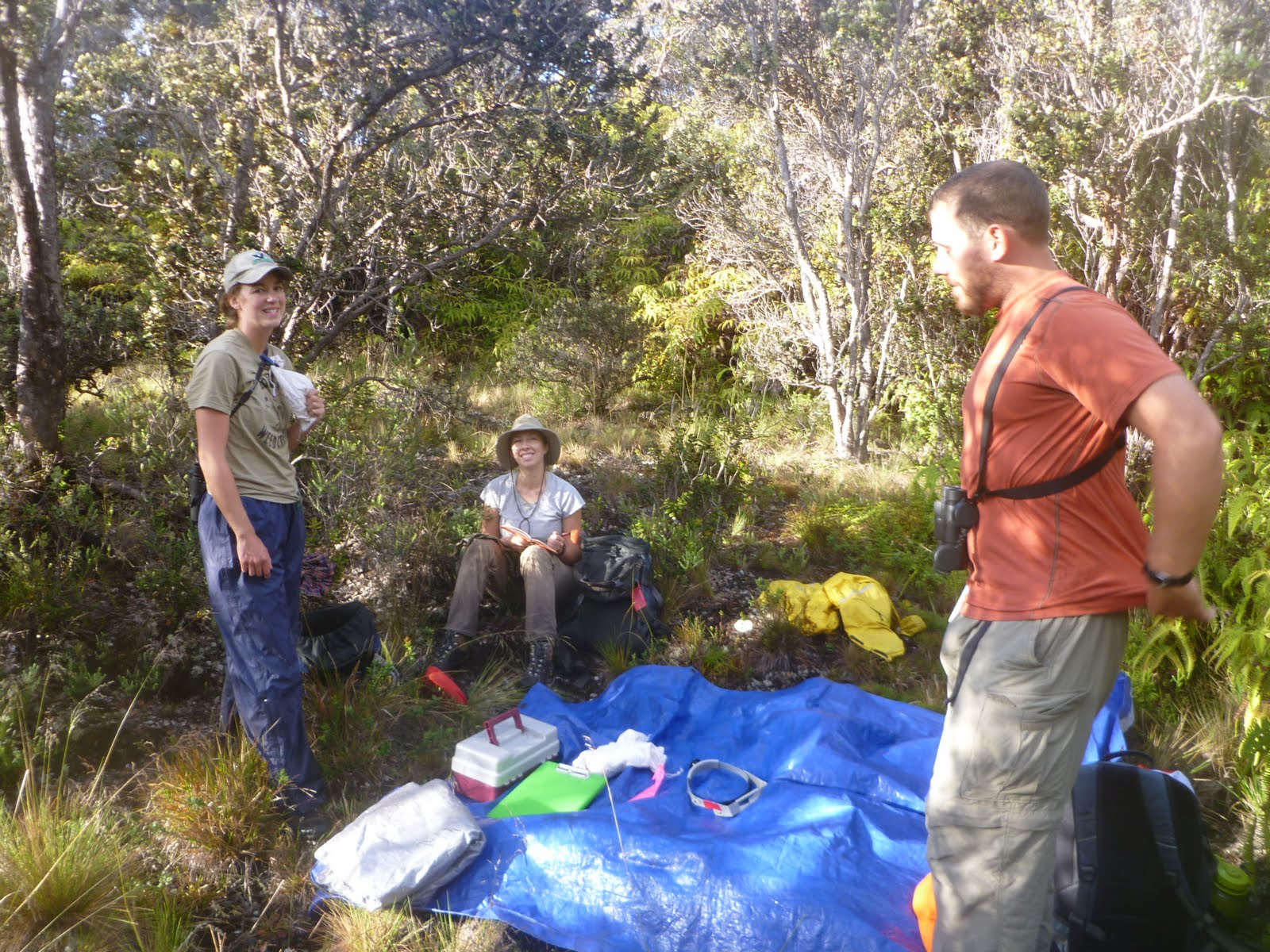
We started out the day by driving up the Saddle Road between the volcanos Mauna Loa and Mauna Kea to about 5000 feet above sea level and identified the Kipuka we were to work at for the next two days.   A Kipuka is basically an area of forest within an ancient lava flow that wasn't consumed by fire and molten rock.  So, as you drive up the Saddle Road, after a certain elevation on either side of the road you generally see vast expanses of hardened black lava, except for a few of these "islands" of forest (Kipukas) that appear up through the blackness.  When the lava flowed down from the cinder cones it flowed around the Kipukas and they were spared from total destruction, meaning that many of these areas are very old-growth forests.  The Hawaiian Honeycreepers have taken up residence in many of these Kipukas, but at lower elevations they've been dying off due to malaria transmitted by mosquitos.  The Forest Service is researching the populations of Honeycreepers within the Kipukas so that they can try to prevent them from going extinct.

When we drove as far as possible we could see the Kipuka about a mile out into the hardened lava.  On the Hawaiian islands there are two types of lava:  A'a (say it like The Count from Sesame Street would) lava and Pahoehoe (Pa-Hoy-Hoy) lava.  If you happen to be hiking on lava, hopefully you're hiking on the relatively smooth and stable Pahoehoe lava, but today's lava was A'a.  A'a is composed of very sharp, very hard, and very poorly distributed basketball to car sized lava rocks piled on top of each other.  The razor sharp rolling hills of lava rocks, with gaps between some of the rocks perfectly sized for a foot to slip between, were extremely unstable.  One rock would be solidly pinned against the next and then the following rock would be teetering on an unbalanced one underneath.  Each step was an adventure.  We carried all of our supplies over this rock for about 45 minutes or so.  No one was seriously hurt, but after two days of walking through the A'a lava my trail shoes were pretty shredded up.
I've edited this post and added a picture of the A'a lava (below).  I didn't think to take any pictures as I was walking through it, so I had to "borrow" this picture from "Mike Watson's Diary" blog.  I hope he doesn't mind.  I've never met him, but his blog looks pretty cool so I'll give it a plug as well http://mikewatsonsdiary.blogspot.com/2008/04/hawaii-2008-with-birdquest.html.  Thanks Mike.
 

But in the end, it was all for the birds...


I'm not sure what species this one was, but they were all pretty cool looking and fun to work with.  They were definitely annoyed, but surprisingly patient with us as we tagged them and documented various observations and measurements.  I'm holding this bird in what they call the "photographer's grip", probably named so because they're easy to photograph like this.

Below, an I'iwi (E-E-Vee) is caught in one of our mist nets.  They're carefully removed and then tagged before releasing again.

You can see that the various species have different sized and shaped beaks and different coloring.  Each has evolved to suit its own unique method of survival.

I have to say that this was the most physically demanding work I've done since my days of working construction.  Props to the U.S. Forest Service Kipuka Team.  They're the Honey Badgers of the U.S. Forest Service. From left:  Olga, Jessie, and Nolan (Sonia not pictured).  I hope to be back soon!

Monday, May 23, 2011

Lunar Landscapes


Astronauts have trained on Mauna Kea because, apparently, it resembles the surface of the Moon.  I enhanced my "other-worldly" experience by listening to Radiohead (Kid A and OK Computer) and Pink Floyd (Meddle and Animals) on the way up.
It's pretty cool when you start looking down at the clouds.  I've lived in mountainous places before, but getting to the top of Mauna Kea involves going from sea-level to almost 14,000 feet above in less than 90 minutes.  I assumed that since I'm in relatively decent shape and have lived in the mountains before, I could skip the recommended 30 minute acclimatization at the 9,000 ft. Visitor Center.  I was wrong.  Whew!!  I should have known when I made a brief stop at the location in the pic above, probably around 11,000 feet and took a short walk around and got extremely winded.  I then ignored my body's warning signals and proceeded straight to the top.
The top is pretty cool, even if you're not a complete astronomy geek.  I am not, but I think space is cool and perplexing.  I took a 100 level Astronomy course at Wayne State University in my early 20's thinking it would be a fun, easy way to get a science credit.  It was hard.  We didn't just look at stars and talk about constellations all night like I expected.

Mauna Kea hosts some of the most advanced telescopes in the world.  Its consistently clear air and low light pollution (see Hilo and Kona's dim, yellow lights at night) from surrounding cities provide astronomers with ideal conditions for viewing the heavens.

But moving on, it was 80 degrees when I left Hilo and 30 degrees when I got to the top of Mauna Kea.  The cold wasn't so bad.  I grew up in Michigan.  I can take it.  But after a short hike I started feeling light headed and was really short of breath.  Yes, maybe I'm not in as good of shape as I thought, but seriously, I was not feeling well.  So, I descended.  My plan was to stay until sunset because I had heard it's worth it, but it would mean staying up at this elevation for another three hours and I thought it would be better to go down for a half hour or so, acclimate, and then come back up.  It worked.  I went down to about 9,000 feet and hung out for about 45 minutes until the light-headedness went away and then cruised back up to the top.

Now invigorated and feeling spry, I decided to cruise around (by car) and look at the beauty and the weirdness of this "Astronomy Domine(ted)" mountain top.  The dome shaped structures, which were much bigger than I had imagined, and swiveling space dishes were really cool to look at, and broke up the otherwise completely barren, wind-scarred landscape of the mountain-top.
So I was actually beginning to get bored.  None of the observatories were actually open, it was cold, and the sun was so intense you couldn't really hang out outside for long even if you wanted to.  Eventually though, I killed enough time to make it to sunset.  That's when the place literally came to life.  As I sat in my truck, the colors on the horizon slowly started to become more vibrant as I looked out over the ocean.  Maui could be seen poking through the clouds in the distance.  Oh, and it started to get REALLY cold.
Glad I packed the ol' ski parka w/hood.  Let's start the show!


Pictures don't do it justice.  They never seem to.  As I was watching the natural beauty appear before me, I started hearing weird buzzing and whirring sounds all around me.  As I looked around, nearly all of the buildings, dishes, and other objects were set into motion, warming up for the real show that happens nightly within the spacey Pac-Man shaped structures.  It was cool just to see everything moving all of the sudden.  Most of the huge observatories swivel, so you're looking at the spherical equivalent of a 10 story building slowly rotating.

On my way down I noticed that the parking lot at the Visitor's Center was packed so I stopped in to see what all the fuss was about.  A bunch of amateur astronomers had set up their telescopes and were letting people view the stars.  It was crowded and I wasn't feeling patient enough to wait in line so I just sat and stared at all the stars that could be seen with the naked eye.

Again, The Big Island delivers.